
What is an Embedding Model?
An Embedding Model is an AI model that converts text, images, or other data into a list of numbers called a vector.
These numbers represent the meaning and characteristics of the input data in a mathematical form that computers can compare.
1. Simple Example
Suppose we have three sentences:
- “How to reset my password?”
- “I forgot my login credentials.”
- “How to transfer money?”
An embedding model converts these sentences into vectors.
Illustrative vectors only (real embeddings may contain hundreds or thousands of dimensions).
| Text | Vector |
|---|---|
| Reset my password | [0.21, 0.85, 0.32, ...] |
| Forgot login credentials | [0.24, 0.82, 0.35, ...] |
| Transfer money | [0.91, 0.12, 0.67, ...] |
The first two vectors are likely to be closer to each other because their meanings are similar.
The third vector represents a different concept.
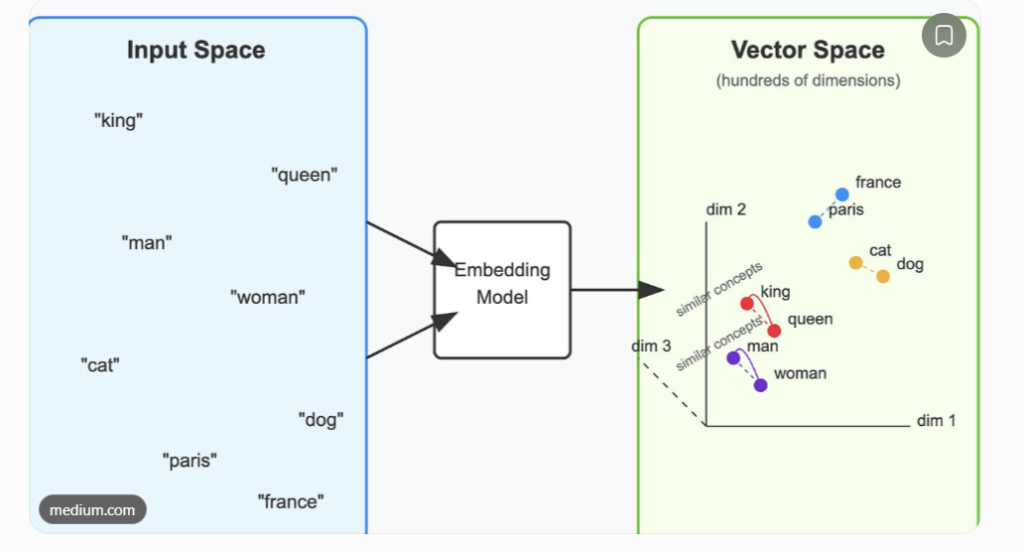
This allows AI systems to search based on meaning rather than just matching words.
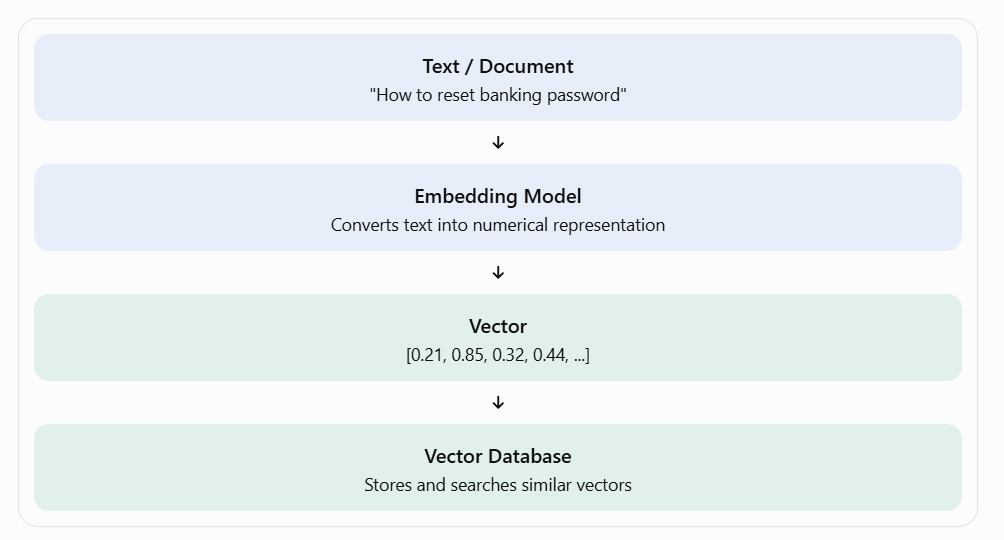
2. How Embedding Models Work with Vector Databases
3. Popular Embedding Models
| Model | Provider |
|---|---|
text-embedding-3-small | OpenAI |
text-embedding-3-large | OpenAI |
nomic-embed-text | Nomic / Ollama |
all-MiniLM-L6-v2 | Sentence Transformers |
bge-m3 | BAAI |
Some models can run locally, while others are available through APIs.
4. Embedding Model vs LLM
| Embedding Model | LLM |
|---|---|
| Converts text into vectors | Generates text and answers |
| Used for semantic search | Used for reasoning and generation |
| Numerical output | Text output (typically) |
Example: nomic-embed-text | Example: llama3 |
5. Example in a Local AI Application
If you use Ollama:
ollama pull nomic-embed-textGenerate embeddings:
curl http://localhost:11434/api/embed \
  -d '{
    "model": "nomic-embed-text",
    "input": "How to reset banking password?"
  }'
The response contains a vector that you can store in PostgreSQL with pgvector or another vector database.
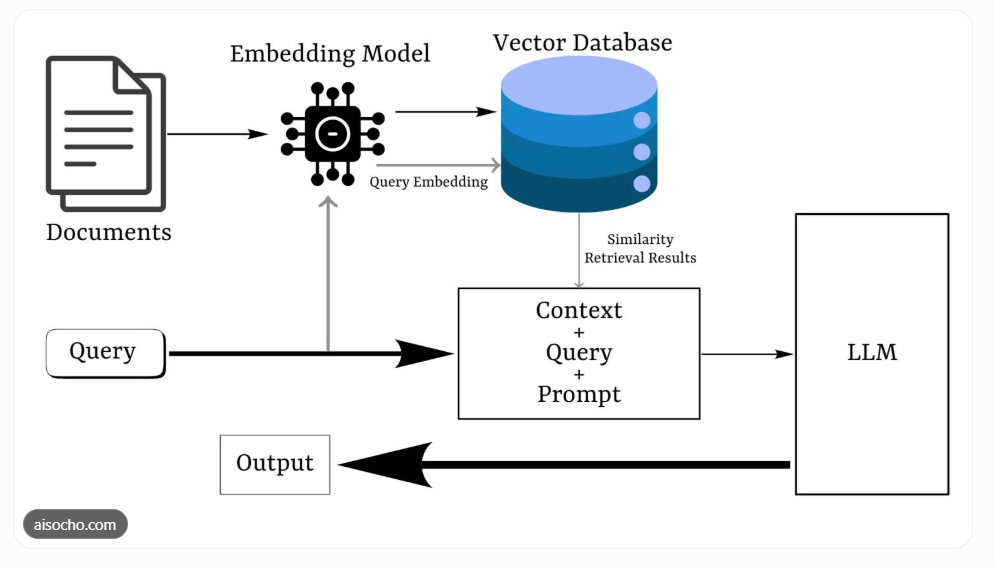
The complete AI knowledge-search flow
Document → Embedding Model → Vector Database → Similarity Search → LLM → Answer
The important distinction:
- Embedding model understands the semantic representation of data.
- Vector database stores and retrieves that representation.
- LLM uses retrieved information to answer questions.