
What is a Vector Database?
A Vector Database is a specialized database that stores and searches data using vectors (numerical representations of information) rather than only traditional text, numbers, or exact values.
It is widely used in AI applications, ChatGPT-like systems, RAG (Retrieval-Augmented Generation), semantic search, and AI agents.
1. How does a Vector Database work?
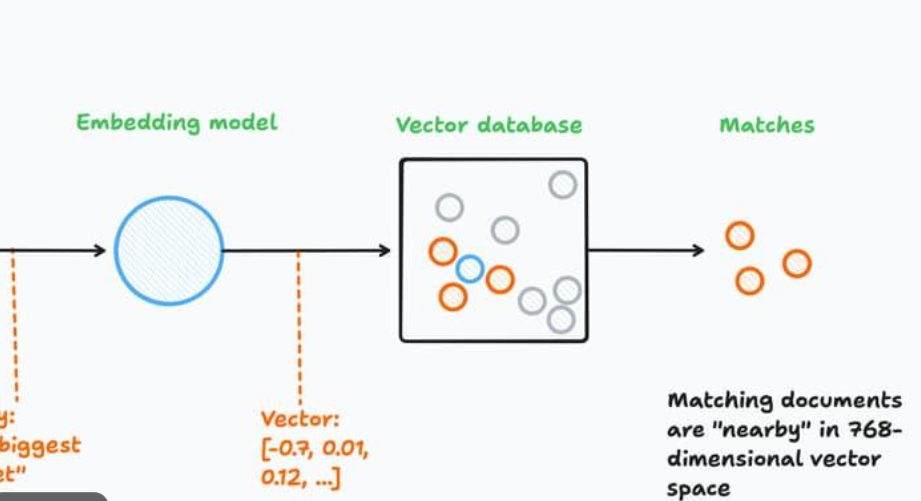
The process generally works in 3 steps:
- Convert data into embeddings: An AI embedding model converts text, documents, images, or other information into numerical vectors.
- Store vectors: These vectors are stored in a vector database along with the original data or its reference.
- Search by similarity: When a user asks a question, the question is converted into a vector, and the database finds the most similar stored vectors.
Example
Suppose you store these documents:
| Document | Text |
|---|---|
| D1 | How to reset my banking password |
| D2 | How to transfer money |
| D3 | How to recover account login credentials |
Now a user searches:
“What should I do if I forgot my password?”
A traditional database may require matching keywords.
A vector database can find D1 and D3 because their meanings are similar, even if the exact words differ.
This is called Semantic Search.
2. Vector Database vs Traditional Database
| Feature | Traditional DB | Vector DB |
|---|---|---|
| Search | Exact match, SQL conditions | Similarity search |
| Data | Rows and columns | Numerical vectors + metadata |
| Search example | WHERE name='John' | Find semantically similar content |
| Query | SQL | Vector similarity |
| Use case | Banking, transactions | AI, semantic search, RAG |
Note: Vector databases can also store metadata and support filtering.
3. Popular Vector Databases
1.Pinecone –Managed cloud vector DB
2. Chroma – Simple AI / RAG development
3. Weaviate – Open-source vector DB
4. Milvus – Large-scale vector search
Other options include Qdrant and PostgreSQL with pgvector.
4. How is it used in AI applications (RAG)?
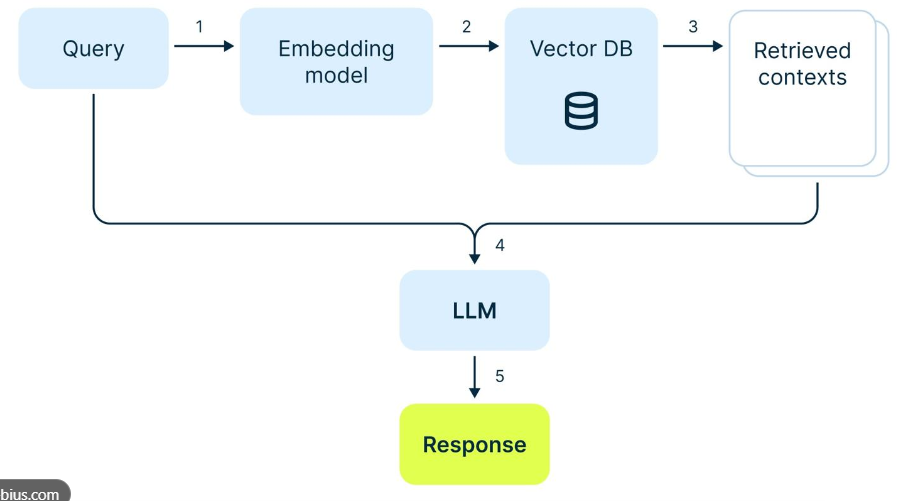
For example, imagine building a Backbase banking AI assistant:
- Upload Backbase documentation, configuration files, and architecture documents.
- Convert documents into embeddings.
- Store embeddings in a vector database.
- A developer asks: “How does Dashboard Service load customer tiles?”
- The vector DB retrieves relevant documentation.
- The LLM uses the retrieved information to generate an accurate answer.
This architecture is called RAG (Retrieval-Augmented Generation).
5. Simple Java Spring Boot architecture
User Question
|
Spring Boot AI Application
|
Embedding Model
|
Vector Database
|
Relevant Documents
|
LLM (GPT / Claude / Local LLM)
|
AI Response
Important: A vector database is not an AI model. It stores and retrieves information that AI models can use.